
Caritas Corner | The Uncomfortable Challenge of Justice

BY ANDY BARTON

What do we owe to the poor?

That question underlies much of our current political and social discourse. We ask it – perhaps subconsciously — when we encounter someone on a street corner asking for money, when we drive through struggling neighborhoods, or when we read about the human impact of government shutdowns or freezes benefit payments. How we answer the question of what we owe our poor reveals something profound about our understanding of charity and justice.

In the Catholic tradition, the word justice has a specific and demanding definition. It is not simply the punishment of wrongdoers or the enforcement of law. It is the condition of a right relationship between people and within society. Catholic Social Teaching articulates this through the principle of preferential option for the poor and the idea that the moral health of a society is measured by how it treats its most vulnerable members. It is a thread, woven through Scripture from the prophets of the Old Testament to the Beatitudes.

Importantly, Catholic teaching does not speak of justice as a naturally occurring state but rather the ideal for which members of society ought to strive.  The prophet Isaiah states this clearly: “Learn to do good; seek justice, correct oppression; bring justice to the fatherless, plead the widow’s cause.” (Is 1:17) This distinction matters enormously today and points to an important difference between justice and charity.

Giving a couple of dollars to someone on a corner or donating cans of soup to a food bank are acts of charity. Acts of charity can be meaningful to those receiving them because they respond to immediate suffering, yet they do little to alleviate it in the long run.  These acts of charity benefit the giver as well. They help satisfy a sense of having done our part. They are transactions that allow us to move on to the next item in our lives.

Justice demands that we ask why the poor are suffering in the first place and then that we work to alleviate those causes.   This is an uneasy paradigm.  It opens our eyes to the possibility that the comforts we pursue for ourselves could be part of the structure that makes poverty persistent. There is nothing inherently wrong with wanting a better home, better schools for our children, and better neighborhoods; however, there is a danger that this becomes a pursuit of luxury that makes us indifferent to, or even dependent upon, the disadvantage of others.

St. Thomas Aquinas wrote of justice as a habit and a virtue, implying that it does not come naturally. What comes naturally is the instinct to protect what is ours. Justice requires the harder, more deliberate act of asking what belongs to our neighbor, and whether we are holding it. It must be cultivated against the grain of our self-interest.

This is the invitation that justice extends to us both as Catholics and as citizens. It is comfortable to respond to poverty with pity. It is harder to respond with the kind of solidarity that requires us to examine the structures that perpetuate it. In his apostolic exhortation Evangelii Gaudium, Pope Francis writes: “I want a Church that is poor and for the poor… They have much to teach us. Not only do they share in the sensus fidei, but in their difficulties, they know the suffering Christ. We need to let ourselves be evangelized by them.”

Our response to poverty must be more than generosity.  It must be just. Justice, by its theological nature, costs those who are prosperous something on behalf of those who are vulnerable. It means advocating for wages that allow families to live with dignity, for housing policies that do not price the working poor out of their communities, and for the kind of civic commitment to the common good that does not evaporate when it becomes personally or politically inconvenient.

Christ not only healed the sick. He challenged the systems and society that left them sick in the first place. In Him, charity and justice are mutually inclusive. They are critical halves of the same act of love, offered both freely and at a price.  We owe the poor care enough to let that love cost us something.

Andy Barton is the CEO of Catholic Charities of Central Colorado. This column is reprinted from the March 2026 edition of The Herald.
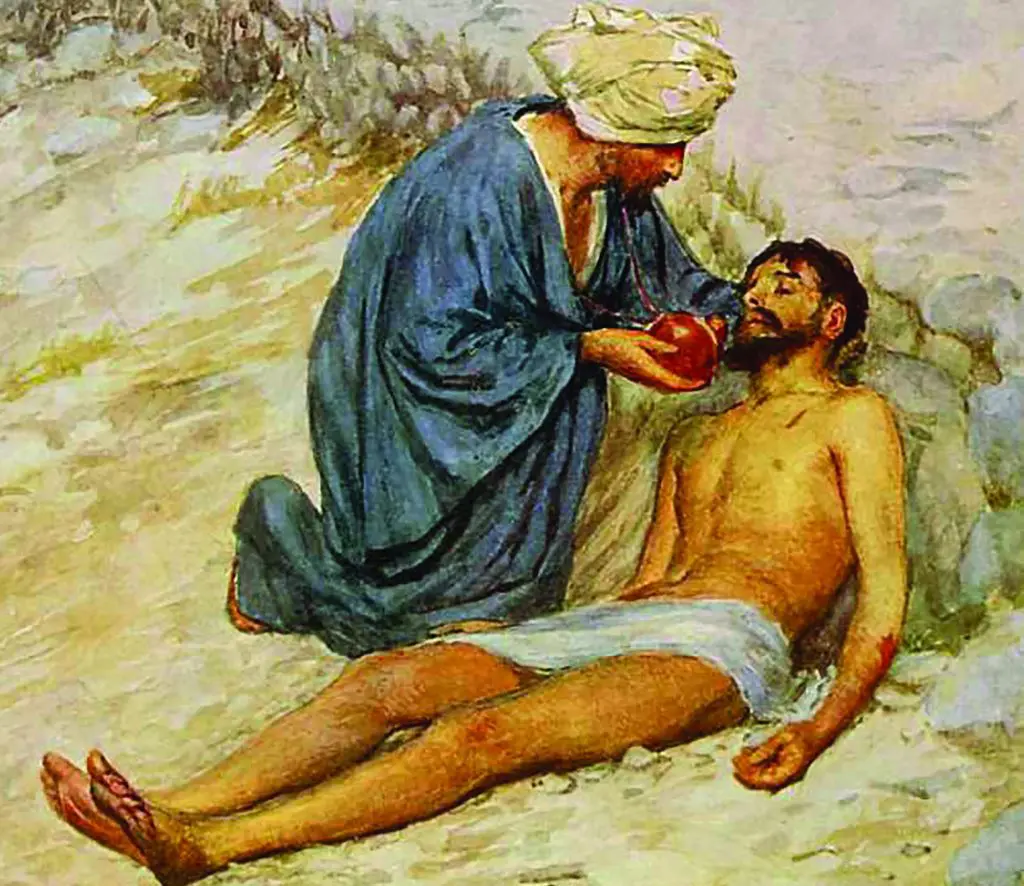
the Good Samaritan

The convention for newsletters like this is to impress upon you, the reader (and hopefully supporter of the organization’s work), how much the organization has done over some period.  We share the number of people served or testimonials from individuals whose lives were changed.  This month, I am going against convention to provide some insight into what Catholic Charities has not been able to do. 

In an average winter month, our Family Connections team receives over 820 separate calls for assistance.  The three most common requests are for financial help with rent, food, and basic needs.  We also field requests for utility assistance, car seats, employment help, and access to government benefits like SNAP and TANF, among other needs.  In addition to the specific crisis expressed in these calls, every outreach comes with a complex background of circumstances that cannot be easily quantified for tracking purposes.  The immediate need is almost always a symptom of a bigger root cause.

Family Connections allocates three staff and a small group of volunteers to managing the response to this constant call volume; yet the constraints of both manpower and money — combined with the complexity of needs — mean that our team is able to help resolve the needs of less than 20% of those calls.  We can offer recommendations or suggestions for the remaining 80%, but we do not have enough people or money to directly address all that is needed.

Those statistics are a snapshot of just one of the services provided by Catholic Charities.  Except for the daily meal served at the Marian House Kitchen, where nobody is turned away, every other program sees demand that eclipses our resources.  To be clear, this is not a result of budget shortfall – through the first half of the fiscal year, we are right on goal with fundraising.  It is simply a result of the size of the need. 

In Chapter 10 of the Gospel of Luke, Jesus delivers the parable of the Good Samaritan, a scriptural cornerstone for the work of Catholic Charities.  The Samaritan tends to the injured man’s wounds and then, importantly, leaves him in the care of an innkeeper, “with the instruction, ‘Take care of him. If you spend more than what I have given you, I shall repay you on my way back.’”

If there were a modern example of the Good Samaritan story, I would suggest that his final instruction to the innkeeper would instead be: “Take care of him but don’t spend too much because you have a lot more on the way and I don’t have enough silver for all of them.”  Today, there are not enough Samaritans for all the injured in our community.  The reality for organizations like Catholic Charities is that the high and unpredictable volume of people in need requires a pooling of funds that ends up diluting the impact that we can have on one individual.  Instead of doing everything for a few, we do a little for hundreds.  This is important and meaningful work, but it does not feel like enough.

Every year, Catholic Charities receives overwhelmingly generous support from people like you who give time and money in support of those we serve.  I wish we had more like you.  More Good Samaritans who could provide more resources that would allow us not only to increase our direct financial assistance to those in need but also allow us to hire more staff to walk hand in hand with those who suffer.  More resources would allow us to scale our impact to the level that our community needs.

This brings me to the 25th anniversary of our St. Patrick’s Day Gala.  This event has become a part of our identity and culture; however, its founding has less to do with St. Patrick’s Day than it did with the natural cycle of philanthropic giving.  It began in 2001 to not only boost giving but also to increase awareness of those unfamiliar with our work.  Those goals remain essential and relevant to this day – it is our time to ask Samaritans to come back to the inn. 

Catholic Charities stands in the place of the innkeeper, ready to receive, shelter, and accompany those whom you, the Good Samaritan, lift from the side of the road. When you choose to attend the Gala, make a gift, sponsor a table, volunteer your time, or invite others to do so, you place resources in the innkeeper’s hands so that, together, we can do more to meet the needs of those who are wounded in our midst.  Realizing the Samaritan’s promise to provide all the silver necessary to do what is needed would be a radical shift in convention.

Andy Barton is the President & CEO of Catholic Charities. This blog was first published in the February 2026 issue of the Catholic Charities Helping Hands Newsletter.

BY DOUG ROUSE

David Wintermute first heard about volunteering at Marian House while teaching Sunday School…using magic!

“Yes, I’m a gospel magician, and I was illustrating Bible verses with magic tricks at Black Forest Lutheran Church when one of the members mentioned their team helped at Marian House. He asked if I wanted to join—and I’m the kind of person who always says ‘yes’ when someone needs help—so I started volunteering around 2019. It was fun, and by now I’ve done about every job except serving soup.”

Dave has always followed his father’s example of serving others. Born in Indiana, he grew up mostly in Arizona. “Dad taught Sunday School in both Indiana and Arizona. He often volunteered in the church, and that inspired me to teach Sunday School even as I moved around in the military.”

Dave entered the Air Force while at the University of Arizona. “I walked into my dorm one day to see a crowd of students listening to news about Vietnam. At one point, an ROTC cadet said, ‘That’s it! This means we are going to war, and I quit.’ The idea of an officer quitting when things got tough struck me hard. So, even though I had not completed my physics degree, I joined up to replace the quitter.” He completed the two-year ROTC program, but the war ended the week before he took his oath of office.

“So the Air Force sent me into space sciences and missile warning at NORAD. During my tenure, they sent me for a Ph.D. and had me work on rocket programs.”

At each base where they were stationed, Dave and his wife, Betsy, found a church where he would teach Sunday School, just like his dad. In addition to his gospel magic presentations, they joined a medieval reenactment group to make history come alive for students. “As a hobby, we joined the Society of Creative Anachronism and would go to schools to show costumes, courtesy, armor, and combat.”

His service in the church has continued since their return to Colorado Springs in retirement.

At Marian House, Dave has found the fellowship and camaraderie of fellow volunteers to be the most fulfilling part of volunteering. “It is satisfying to know that there are other good people out there who are willing to give their time and effort to help those in need.” If you see him in the kitchen or cafeteria one day, just call him ‘Dr. Dave.’

“I love the alliteration—but I’m a retired rocket scientist, not a medical doctor, so don’t ask me for aspirin.”

And his advice for those seeking meaningful service? “Do it: Volunteer at least once to see what it’s like to help others.”

Doug Rouse is the Volunteer Director for Catholic Charities of Central Colorado. This article appeared in the January 2026 issue of Volunteer Voice.

BY ANDY BARTON

At this writing, a historic government shutdown has left flights delayed and civil servants without pay. More importantly, for over 42 million people who depend on the Supplemental Nutrition Assistance Program (SNAP) and six million families relying on support for Women, Infants, and Children (WIC), the government’s promise of food security has been broken. The safety net that so many count on has become riddled with holes, leaving the most vulnerable further on the margins and feeling left behind.

When the government falters, the poor and the vulnerable feel it first. Politicians on both sides offer public sympathy for the suffering, but far too often their real energy goes into blaming each other. Blame is endlessly easier than compromise.

Perhaps, by the time you read this, Congress will have struck a deal and reopened the government.  If that is the case, I suspect the outrage over cancelled flights and potential disruption of holiday travel was the proverbial hold that made both sides cry uncle.  The anxiety and pain endured by millions of hungry families have not, thus far, convinced our federal government to fund SNAP and WIC.  When a deal is reached and the headlines move on, the wounds suffered by those who rely on these programs will linger.

Reason for hope arrived beyond the news cycle in October through a quieter but profound challenge to the Church: Pope Leo’s first Apostolic Exhortation, Dilexi Te (“I Have Loved You”). In his letter “To All Christians on Love for the Poor,” Pope Leo speaks with urgency and clarity, reminding us what it means to follow Christ in a world of inequality. Drawing upon Evangelii Gaudium and the heart of Catholic Social Teaching, he underscores that care for the poor is the beating heart of the Christian life.

The timing of our new Pope’s first apostolic exhortation is profoundly meaningful.  As the government flounders, his words arrived to remind Christians to step into the breach for the poor.  Pope Leo writes, “God has a special place in his heart for those who are discriminated against and oppressed, and he asks us, his Church, to make a decisive and radical choice in favor of the weakest.”

If the shutdown teaches anything, it is this: the poor cannot wait for political solutions. Catholic Social Teaching has always recognized that while government can and must play a role in addressing poverty and injustice, it is not sufficient. The Gospel’s command is personal, communal, and enduring. When government falls short, the People of God must rise up.  What better time to remind and recommit ourselves to this call than the season of Advent?

The Church calls Advent a season of hopeful waiting and preparation. Yet Pope Leo reminds us: hope without action for the poor quickly becomes hollow, even dangerous. If our Advent preparation is only about internal devotion, comfortable ritual, or social gatherings, we miss Christ’s invitation to listen and respond to the cries from the lines at food pantries, anxious faces at shelter doors, and families grasping for dignity.

Pope Leo quotes Pope Francis in reminding us that caring for our poor is more than a seasonal responsibility; it is the essence of discipleship.  He warns Christian faithful not to lose sight of this role. “Any church community, if it thinks it can comfortably go its own way without creative concern and effective cooperation in helping the poor to live with dignity and reaching out to everyone, will also risk breaking down… It will easily drift into a spiritual worldliness camouflaged by religious practices, unproductive meetings, and empty talk.”  

The Church, whether through localized parish work or the more expansive work of Catholic Charities and other ministries, is uniquely positioned to respond not just with programs, but with authentic human presence. Food pantries, emergency shelter, advocacy, and accompaniment all spring from relationships rooted in a shared sense of dignity, not transactional charity. It is precisely in moments of public failure that our Christian authenticity is tested.

Dilexi Te reiterates the foundations of Catholic Social Teaching in reminding us that our love for Christ is proven in how we love and serve those whom society forgets. The government may provide resources, but only faith, hope, and love can offer solidarity and care for the common good. Our homeless, our hungry, and our poor are members of one beloved and necessary body.

This Advent, Pope Leo’s exhortation should echo throughout what we do. It can spark the compassion to move us beyond words to deeds, and real kinship to make our Church a living reflection of a love that refuses to leave anyone behind.

Andy Barton is the President and CEO of Catholic Charities of Central Colorado. This was first printed in the Nov/Dec issue of The Herald, the official magazine of the Diocese of Colorado Springs.

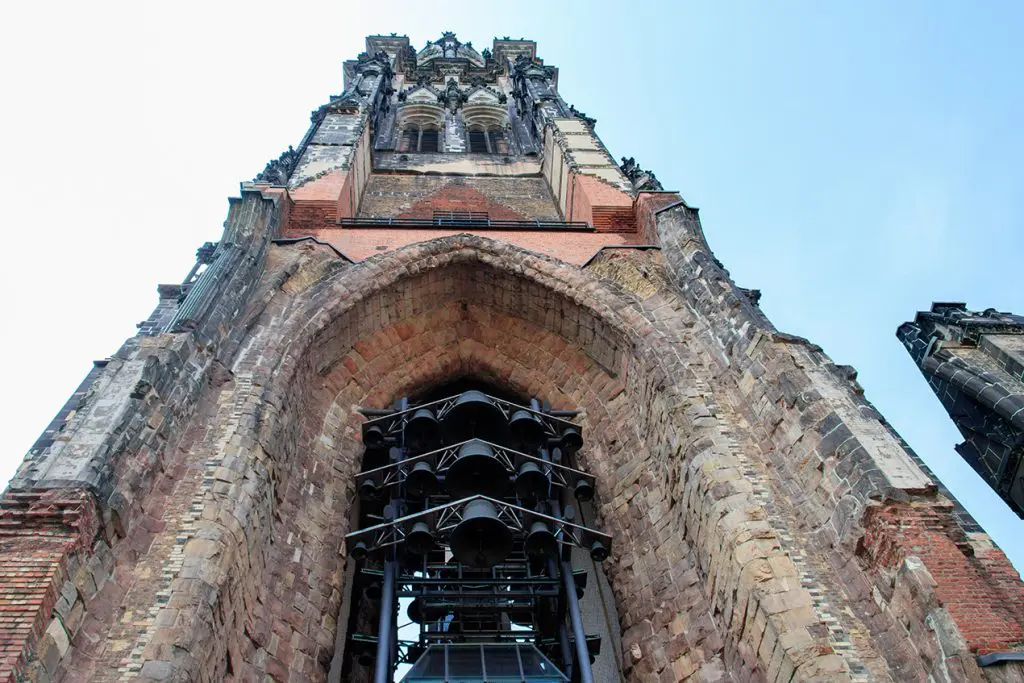
A low-angle horizontal shot of the Gothic revival church of St. Nicolas in Hamburg under the blue sky

BY ANDY BARTON

Dominating the skyline of 1200-year-old Hamburg, Germany, stands the towering ruins of St. Nikolai Church.  At the time of its reconstruction in 1874, it was the world’s tallest building. Today, it is a blackened skeleton of its former glory and a haunting reminder of one of the most devastating bombing campaigns of World War II. In July 1943, the Allied Combined Bomber Offensive launched Operation Gomorrah, a multi-day campaign that culminated in some of the war’s most devastating firebombing.

Hamburg feels newer than other European cities.  It was effectively destroyed 82 years ago and had to be rebuilt from the ashes.  The remains of St. Nikolai serve as a chilling reminder of war’s devastation. In its current incarnation, Hamburg has transformed this sobering spectacle into a memorial that calls attention to the destruction of past and present conflicts, including memorials to lives being lost in Ukraine and Palestine.

There is a profound sense of evil in the casualties of war—something especially pronounced in our understanding of World War II.  The atrocities committed by the Nazis are as clear an example of evil as the modern world has ever known. Yet standing at the base of St. Nikolai, contemplating the 37,000 German citizens who perished and the historic city that was destroyed, one wonders: why did it have to come to that end, and what could have been done to avoid it all?

This is the same anguished question so many are asking in the wake of the tragic shooting at Annunciation Catholic School on August 27. It was an act of pure evil personified that should prompt a righteous rage in all of us. Yet the familiar responses grow more tiresome with each repetition. There are valid arguments around gun control, increased school security, mental health treatment, and other calls for change, but the fact that these discussions have become so politicized and polarized signals that they will continue to prove inadequate as standalone solutions. While this reality doesn’t preclude us from continuing to seek and work toward comprehensive reforms, it suggests we need to examine the deeper roots of the problem. One wonders: why did it have to come to that end, and what could have been done to avoid it all?

Edmund Burke, the philosopher and politician, has been credited with the oft-repeated declaration: “The only thing necessary for the triumph of evil is that good men do nothing.” While thought-provoking, the sentiment misses the mark in its emphasis on what “good men” fail to do. The more appropriate statement would be that evil triumphs when people fail to pursue good.  Good as in love, caring, and kindness. Good as in smiling at, greeting, or consoling a stranger. Good as in volunteering, lending a hand, and sharing. Good is deeds, outlooks, and belief systems. The opportunities to do good are omnipresent; sadly, our society’s tendency to act on them is far less consistent. All the while, the evil that leads people to shoot children in schools festers in our society, “seeking the ruin of souls.”

We know the Minneapolis shooter was a former student who expressed fascination with mass shootings as well as anti-Catholic and antisemitic sentiment—all of which can justly be characterized as evil. We do not, and probably cannot, know what caused that evil to enter his heart and mind; yet, if we could somehow look back at his life, I am convinced we would find a trail of missed opportunities when someone could have done good.    

I felt the same way standing in the shadow of a burned church in Hamburg.  So much could have been done to change the dark trajectory of Germany if more people had done good. Instead, we are left with the sobering reminder of what comes when evil is allowed to flourish unchecked.  The ruins of St. Nikolai Church will stand as a monument to destruction for generations to come. Still, around those ruins, Hamburg has rebuilt a vibrant city.  It is proof that in evil’s aftermath, good can triumph. That same hope must drive our response to every act of evil we encounter in our own communities and our own hearts.

As we pray for the victims of the Annunciation school shooting, let us not feel helpless.  Instead, let us recall Paul’s instruction in his letter to the Romans: “Do not be conquered by evil but conquer evil with good” (Romans 12:21).  We can do it, one deliberate act of kindness, one moment of compassion, one choice to love rather than hate at a time.

Andy Barton is President & CEO of Catholic Charities of Central Colorado. This article was first published in the Sept/Oct 2025 issue of The Herald.

BY ANDY BARTON

On August 20th, Catholic Charities celebrated the grand opening of Hunt Family Housing, a 24-unit facility that will provide stable housing for families exiting homelessness. This project, which began in January 2022, became a reality due to the generous support of hundreds of donors as well as funding from the State of Colorado. As proud and excited as we are by this accomplishment, at the end of the day, Hunt Family Housing is just a building. The work that we will do with the families who live in that building is where the transformational change will occur.

Our approach has been formed by over two years of researching best practices and is grounded in both the timeless wisdom of Catholic Social Teaching and the rigorous insights of evidence-based practices. As we prepare to welcome families into Hunt Family Housing, I want to share why our four-pillar model represents not merely a best practice, but a faithful response to Christ’s call to serve “the least of these” with excellence and compassion.

Pillar One: Dedicated Case Management as the Foundation
Intensive case management forms the cornerstone of effective family support. Studies show that families receiving dedicated case management services realize dramatically improved outcomes compared to those receiving standard services. Our case managers (which we call Life Coaches) at Hunt Family Housing will maintain low caseloads, enabling them to provide the intensive, relationship-based support that is critical to success. This approach recognizes that homelessness is rarely about housing alone; it involves complex interactions between economic hardship, trauma, health challenges, and systemic barriers that require skilled, sustained intervention to address effectively.

Pillar Two: Behavioral Health Services as Essential Medicine
The behavioral health needs of families experiencing homelessness are both profound and often overlooked. Research indicates that homeless children face heightened challenges from trauma, mental illness, and behavioral problems, while their parents struggle with their own mental health issues, often compounded by histories of domestic violence and trauma. This research informed our decision to provide dedicated behavioral health therapists for each family, ensuring that mental health support is not an afterthought but an integral component of the healing process.

Pillar Three: Parent Education as Empowerment
Effective parenting requires skills that many parents, particularly those facing the stress of homelessness, may never have had the opportunity to develop. Research has found that parent education programs can build resilience in families experiencing homelessness by enhancing parental health literacy, sensitive parenting behaviors, and child self-regulation.
The evidence for parent education’s effectiveness is particularly strong when services are delivered in supportive environments. Studies show that home visiting programs—which share many characteristics with our on-site parent education services—effectively increase positive child health indicators, improve parenting skills, decrease risks of abuse and neglect, and reduce parental depression.

Pillar Four: Trauma-Informed Architecture as Healing Environment
The physical environment profoundly impacts healing and recovery, particularly for individuals who have experienced trauma. The emerging field of trauma-informed design recognizes that the built environment can either support or hinder therapeutic progress. For families who have experienced the trauma of homelessness, the design of their living space becomes an essential component of their recovery.

The renovation of Helen Hunt Elementary School incorporates these principles throughout. High ceilings and large windows provide natural light and visual connections to the outdoors. Individual family units offer privacy and control, while common areas encourage community building. The preservation of the building’s historic character provides identity anchors that research identifies as important for psychological well-being.

This four-pillar model represents more than a service delivery framework; it embodies our fundamental conviction that every person possesses inherent dignity as a child of God. Catholic Charities’ mission calls us to create conditions where all people can “fully achieve their God-given potential.” When families receive comprehensive, coordinated support addressing their housing, mental health, parenting, and environmental needs, this transformation becomes not just possible but predictable.

When we serve the poor with excellence, we encounter Christ himself. The four-pillar model at Hunt Family Housing will transform not just housing situations but entire family trajectories, bearing witness to the Gospel truth that no one is disposable, and every life is valuable. In this way, we aim to end family homelessness, one sacred encounter at a time.

Andy Barton is the President and CEO of Catholic Charities of Central Colorado. This article first appeared in the September issue of Helping Hands Newsletter.

Ruth recognized the warning signs. If she stayed, things would spiral. Fear gripped her, but when her son said, “Mom, we’ll be okay on our own,” she knew it was time. With only what they could carry, they walked out the door and never looked back.

Her church family stepped in, offering temporary shelter — couches and floors to sleep on — but they were safe. Determined, Ruth sought help and found Catholic Charities, where she met a navigator at Family Connections. They helped with food, clothing, and resources, guiding her to the Hanifen Center to build a resumé and start her job search.
“Asking for help was hard. It felt like failure,” Ruth admitted. “But Sarah, my caseworker, reassured me: ‘We all fall down. Let’s just get up.’”

Ruth was assigned a life coach, who helped her set goals and explore a variety of housing options. Though grateful for her church’s kindness, she knew they couldn’t stay forever. The strain was real: being extra guests in someone’s home is never easy. On her son’s birthday, they felt the tension and made the decision to move to a shelter after his birthday dinner.

But that night, everything changed. As dinner cooked, Ruth’s phone rang. Her life coach urged her to meet Maria, her supervisor, that very evening. In the falling snow, Ruth rode a bicycle to the address. Once there, Maria handed her a lease. The emergency housing she was standing in was theirs if they wanted it. Ruth was ecstatic. She rushed home to get her son and their limited belongings. That night, Ruth unlocked the door, turned to her son, and saw his face light up. They had a home.

At one of their weekly meetings, Sarah encouraged Ruth to apply for a job helping veterans with PTSD. She hesitated, but with Sarah’s support, she applied and was hired. It was a step toward her ultimate goal: reinstating her nursing license and returning to the career she loved.

Months later, a spot opened at Partners in Housing — a transitional housing agency. It was the next step toward stability. Ruth earned her nursing license back, bought a car, and is working full-time. Life isn’t perfect, but she has a plan, a home, and a future.

“This journey changed me,” Ruth reflected. “I never knew Catholic Charities had so much to offer—housing, food, education, medical care—all hidden in the heart of our city. I thank God for these beautiful people. They gave me the courage to move forward, one step at a time.”

My name is Scott Prast. I have been volunteering with the Wednesday Peace Team for the Marian House food service shift since 2023. My volunteer journey started when I was a teenager. I spent my Sundays volunteering after church, serving lunch to those in need. I was also active in the Boy Scouts, lending a hand through various community service projects. 

After my teenage years, I went to college and took a job as chief mechanic for the world’s largest airship company, The Lightship Group. I worked on blimps across the U.S. and Europe, maintaining aircraft for clients like Monster.com, Saturn, Sanyo, MetLife, and more. That chapter of my life was full of unforgettable moments—I was atop the World Trade Center just one day before the towers fell. I was at the Daytona 500 when Dale Earnhardt tragically lost his life. Overseas, I was even featured on the front page of the London Times lifestyle section in a piece about foreigners on the move. For six years, I lived out of hotels, crisscrossing the globe. It was a whirlwind, and I loved every moment. 

When I was ready for my next chapter, I enlisted in the U.S. Army. I served in war zones and, in 2009, happened to be at the gym just two blocks away when the Fort Hood shooting took place. After that, I took one of the best drives of my life—the Alaska Highway—and moved to Alaska. From there, I was deployed to Pakistan, where I was stationed just 75 miles from where Osama bin Laden was living—three months before President Obama launched the raid that ultimately captured him. 

Cold weather eventually wore thin, so I headed to Hawaii, where I was fortunate to land some amazing assignments. That led me to Indonesia, Japan, and South Korea. After years of travel and service, I returned to Colorado, medically retired, married my wife Jenna, and welcomed our son into the world. 

God has shown me more than I could ever express in words. I’m deeply grateful to be an American—to live in a country where we can worship freely. That kind of freedom is rare, and I’ve never taken it for granted. 

The need for help in our communities is greater than most people realize. That’s why I volunteer as often as I can. Eventually, my path led me to the Marian House—just a few blocks from where I first started volunteering all those years ago. Life really has come full circle. 

BY ANDY BARTON

To this day, I can recall watching “Predators of the Mara,” a rerun of Mutual of Omaha’s Wild Kingdom, on a quiet Sunday afternoon in the early 1980s. In that episode, a cheetah chases down and kills a young wildebeest. It is a remarkably brutal scene of struggle for the wildebeest to get free from the cat’s jaws locked on its neck.  The horror I felt as I watched one animal kill another was tempered only by the calming voice of Marlin Perkins, who explained that the herd was ultimately stronger because predators in the Maasai Mara National Reserve helped to cull the sick and the weak. This was natural selection—survival of the fittest.

We generally accept the natural law of the Mara—or any ecosystem—where the predator-prey relationship is fundamental to survival with the exception for one species: homo sapiens. Among wildebeests, it seems reasonable that the herd is strengthened by the elimination of its weakest members. Theoretically, one could argue that humanity would be stronger without the weak and the sick. Yet, as a species, we reject this logic.  The cold, scientific reasoning of natural selection may apply to animals, but it clashes with our moral instincts. Instead, we consciously choose to care about—and care for—one another, often at great personal and collective cost. Why do we do this? What compels us to act against the laws of nature?

The simplest answer may be the one found in the first chapter of Genesis and especially 1:26,27:  “Then God said: Let us make human beings in our image, after our likeness. Let them have dominion over the fish of the sea, the birds of the air, the tame animals, all the wild animals, and all the creatures that crawl on the earth. God created mankind in his image; in the image of God he created them.”  Equally compelling is the commandment in Matthew 22:37-39: “You shall love the Lord, your God, with all your heart, with all your soul, and with all your mind. This is the greatest and the first commandment. The second is like it: You shall love your neighbor as yourself.” These verses stand out among countless others in the Bible in telling us that we care for each other because God made us, and God commanded us to love one another.

There is a deeper logic at work here, one that bridges theology and evolutionary science. If, in nature, the herd is made stronger by the removal of its weakest members, then the inverse is also true: the herd is only as strong as its weakest member. If humankind refuses to abandon our weakest, then it is in everyone’s best interest to support and uplift them. Our collective strength depends on how we care for those who are most vulnerable.  This is the essence of the principles of Catholic Social Teaching, especially care for the common good and solidarity.

Which brings us to our new Pope. In his first address to the crowd in St. Peter’s Square, Pope Leo XIV declared that his motto would come from Augustine’s words: In Illo uno unum, which translates to “In the One, we are one.”  It is a profound theological vision rooted in the Augustinian tradition—a tradition that shaped Pope Leo XIV during his years as a scholar and as a bishop. Augustine’s understanding of humanity was not defined by competition or exclusion, but by the radical unity that comes from being created in the image of God. For Augustine, the health of the community depended on the well-being of each member; true strength is found not in the survival of the fittest, but in the flourishing of all.

Pope Leo’s track record as a bishop speaks to this conviction. He was known not only for his intellectual rigor but for his tireless advocacy for the poor, the sick, and the marginalized. He understands that the Church’s mission is not to mirror the laws of the wild, but to embody the law of love. In the face of global crises—inequality, migration, war— Pope Leo’s Augustinian background equips him to call the Church, and the world, to a higher standard: to recognize that our future depends on how we treat the weakest among us.

None of this is especially insightful or intellectually profound.  Why take up valuable white space in the final issue of the Catholic Harald pontificating on Wild Kingdom and the Bible while reiterating the bio of our new Pope?  Because these are hard times for homo sapiens and I worry that in our politics, our nationalism and even in our fandom, we sometimes lose sight of the imperative to care for each other.  In this, Pope Leo XIV brings me hope. His leadership promises to remind us that, in the One, we are indeed one—and that our greatest calling is to care for each other, not because it is efficient or expedient, but because it is what separates us from the wildebeest on the Mara and makes us truly human. 

Andy Barton is the President and CEO of Catholic Charities of Central Colorado. This column was first published in the July 2025 issue of the Colorado Catholic Herald.

My name is Roswitha Valdez. I was born in Crailsheim, Germany, in 1958 and grew up in a little farming village with 14 other families. We weren’t farmers. My mother was a widow with five children and very little income.

During the harvest season, my family would help harvest potatoes and sugar beets. My best friend and I would have a contest to see who could pull the most beets, which made it fun for us. Our pay for harvest work was potatoes, canned meats, vegetables, eggs, and freshly-baked bread. If you have been to Germany, you know bread is an important “Food Group” to Germans. 

One of my favorite childhood memories is when my mother and I went to the Catholic Charities in Crailsheim to receive some used donated items. I was six years old and in heaven when I was allowed to pick out a blue doll carriage (I can still see it in my mind), a doll, winter boots, and a warm jacket. I’m forever grateful for all the help we received from Catholic Charities.

My mother passed away when I was 14 years old, and I went to live with my much older brother and his wife. I thank God for bringing my husband and me together. Oscar was in the Army and stationed at McKee Barracks in Crailsheim. Lucky me! We were married in 1981 and moved to the US in November of 1982. I was excited and scared to move to a new country far away from my family. In 1987, the Army stationed Oscar in Bamberg, Germany, for three years, so we were able to live in Germany again. After six different moves, we were moved to Colorado Springs in 1994. We fell in love with Colorado and decided to retire from the Army in 1998 and stay here. 

I started volunteering at the Marian House on Wednesdays in 2004. I used to come in at 7 a.m. to help with food prep, and then I helped with serving. Things changed during COVID, and now I arrive at 9:45 a.m. and help wherever needed. During lunch, I usually serve veggies.

I’m happy to come here. I have met so many wonderful, warm-hearted, selfless individuals, both young and old alike. Some of them have become good friends. I enjoy giving back and helping those in need within our Colorado Springs Community.

BY ANDY BARTON

Over 10 years ago, as I was preparing to come to work for Catholic Charities, a friend suggested I read Evangelii GaudiumThe Joy of the Gospel, Pope Francis’ first apostolic exhortation.  In those pages, I found not only an articulation of Catholic Social Teaching that would provide the practical foundation for the work of Catholic Charities but also the honest voice of love and mercy that Pope Francis brought to the world.  In that way, he has always felt like a guide in this work, and, like so many, I am deeply saddened by his passing.

Pope Francis was a shepherd whose papacy was defined by humility, courage, and a radical embrace of the poor and marginalized. His legacy is not just one of words, but of actions—actions that echo in the daily work of Catholic Charities of Central Colorado and inspire our mission to serve.

One of the most surprising and telling effects of Pope Francis’ passing has been the number of non-Catholics who have reached out to express their sympathy.  He was embraced by people of all faiths who found in his words inspiration and comfort.  In a world of increasing divisiveness, Pope Francis was a unifier who reminded us that our humanity is our most essential commonality.  As he wrote in Evangelii Gaudium, “I exhort all countries to a generous openness which, rather than fearing the loss of local identity, will prove capable of creating new forms of social synthesis.”

His papacy was not without challenges. He was unique as a world leader who created controversy not for its own sake, but for the sake of those who had no voice in the sphere of decision making.  In that pursuit he faced fierce opposition as he sought to reform the Vatican, address the pain of clerical abuse, and shift the Church’s focus from culture wars to issues of justice, mercy, and care for creation. 

Nor was Pope Francis without critics.  He was authentic and unapologetic in his commitment to those on the margins, willing to call out the power structures that he held responsible.  As we are reminded throughout the Gospels, criticism follows those who are willing to speak uncomfortable truths and who have a platform from which the world can hear them. 

Pope Francis called us to see Christ in the faces of the hungry, the homeless, the immigrant, and the outcast. He challenged the Church and the world to move beyond comfort and encounter the fullness of humanity, insisting that “when we stop encountering the fullness of our humanity, we lose something of ourselves, and we weaken the fabric of our communities.”  He taught us that faith is not an escape from the world’s pain, but a summons to enter it with love. His legacy lives on in every act of kindness, every meal served, every life transformed. Let us honor his memory by continuing to walk hand in hand with those in need, building a community where hope is not just a word, but a reality.

Andy Barton is the President and CEO of Catholic Charities of Central Colorado. This column was published in the May 2, 2025 issue of The Colorado Catholic Herald.

BY ANDY BARTON

“I had nowhere to go.”

This is a phrase we often hear from those who turn to Catholic Charities for help.  It is voiced by mothers unable to afford diapers or formula, by families facing eviction, by individuals sleeping on the streets, and by immigrants seeking a legal pathway to citizenship. They arrive at our doors in Castle Rock and Colorado Springs — tired, frightened, and hungry. For these individuals, Catholic Charities represents their last hope.

While our commitment to this work is rooted in our Catholic faith, we operate within the framework of the state, which also bears a responsibility to its people. For this reason, we closely monitor government actions at all levels.  Currently, at the top of the list are President Trump’s executive orders and Congress’s budget negotiations.  While part of our interest lies in the funding we receive through government grants, the broader concern is how proposed cuts to departments like HUD and programs such as SNAP and Medicaid will affect those living on the margins.  If these supports are lost, many more people will be turning to Catholic Charities for help.

Catholic Charities of Central Colorado administers government grants and, thus far, has not experienced direct funding cuts.  In our upcoming fiscal year, we have budgeted 11% of our contributed revenue to come from both state and federal government funding. This is a significant decrease from 21% in our current fiscal year and 42% in 2022 during the peak of COVID-related funding. Most of this funding goes directly to clients, primarily as rent assistance. Therefore, any cuts would directly impact our ability to serve those in our community who are at imminent risk of homelessness.

The larger concern lies in potential cuts to food and health care programs.  The budget resolution proposed by the House includes a $230 billion reduction to the Supplemental Nutrition Assistance Program (SNAP) over the next decade.  SNAP, formerly known as the Food Stamp Program, is the largest federal initiative addressing hunger and food insecurity among low-income Americans.  Such cuts would have devastating consequences for vulnerable households across our 10-county Diocese, exacerbating food insecurity, especially for families.  Sixty percent of SNAP recipients are families with children; in El Paso County alone, more than 30,000 children benefit from this program.  Cuts to Medicaid or reductions in Housing and Urban Development (HUD) funding would have equally dire ramifications for those living on the margins.

It is easy to blame politicians or the government for these challenges. Republicans often cite “fraud, waste, and abuse” as justification for cuts, while Democrats label such measures as draconian and cruel. The truth likely lies somewhere in between. Government spending plays a critical role in the social safety net of the United States, but the state shares this responsibility with both the charitable nonprofit sector and, more importantly, the church. Both are explicitly charged with relieving the burden on government by virtue of their tax-exempt status. 

This principle was eloquently expressed by Alexis de Tocqueville in Democracy in America. He admired America’s tradition of collective problem-solving through associations — especially churches — and described it as “self-interest rightly understood,” where helping others ultimately benefits individuals and communities alike.  Tocqueville believed this strengthened democracy while reducing reliance on government intervention. Government support for the poor should never overshadow the Christian works of mercy.

Catholic Charities’ mission to care for the poor is not founded in government funding but in Jesus Christ: “Whatever you did for one of these least brothers of mine, you did for me.If Congress reduces funding for SNAP or Medicaid, or if food and transportation costs continue to rise, more people will turn to us for assistance.  If the government cuts grants, then we will need funding from somewhere or someone else.  But we will keep going, never closing our doors to those with nowhere else to go.

Andy Barton is the President and CEO of Catholic Charities of Central Colorado. This column was first published in the May 2025 issue of Helping Hands quarterly newsletter.

United States Air Force Academy (USAFA) recent graduate Billie Botes’ commitment to service found a powerful home at the Marian House Kitchen, where she began volunteering three years ago.

Athletic community USAFA cadets have been volunteering for the Marian House Sunday meal since 2013, sending different athletic teams each Sunday during their semesters. That is how Billie first volunteered, in her sophomore year, with her boxing team. She loved it so much, she quickly made it a regular part of her Sundays, volunteering independently from the athletic community program. Her consistent presence and warm demeanor made her a familiar and uplifting figure to the Marian House guests, her fellow volunteers, and the staff. David Allee, the Weekend Operations Manager, noted how Billie brought “smiles and laughter,” listening attentively to guests and offering encouragement—qualities that made a lasting impression.

Billie’s commitment to Marian House extended beyond individual service. She invited her fellow cadets from the USAFA boxing team to join her regularly, turning volunteerism into a consistent team-building experience for the boxing team. Those shared Sundays strengthened bonds among teammates and reinforced their team motto: “Tough times don’t last; tough people do.” The experience also deepened their understanding of the Air Force core value “Service Before Self,” as they witnessed firsthand the impact of service and compassion for the guests at Marian House.

One of the most profound outcomes of Billie’s volunteering at Marian House was her relationship with Marine veteran Carl Lewis, who had been homeless for 25 years. Through months of trust-building, Billie helped connect Carl to Rocky Mountain Human Services, ultimately securing him permanent housing. Her ability to relate to Carl as a fellow member of the military community, combined with her steady presence at Marian House, made all the difference.

Billie’s story is a powerful example of caring for our neighbors. Every connection has the power to uplift, to breathe life into aspirations, and to transform lives.

BY ANDY BARTON

Taking a child he placed it in their midst, and putting his arms around it he said to them, “Whoever receives one child such as this in my name, receives me; and whoever receives me, receives not me but the One who sent me.” Mark 9:36,37

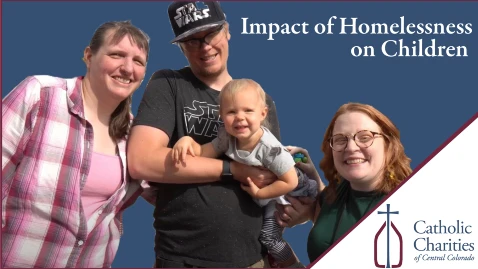
Over 150,000 children in the United States experienced homelessness on a single night in 2024. That finding, taken from the annual Point in Time (PIT) count, was part of a December report from the Department of Housing and Urban Development (HUD) on the state of homelessness in the United States.  The same report indicated a 40% increase in family homelessness nationwide in 2024. The PIT count in Colorado Springs this past year identified 265 children experiencing homelessness and a 12% increase in homeless families. Douglas County reported four children experiencing homelessness.

The PIT count, however, is an imperfect methodology for capturing the number of homeless children and families. A better indicator is the Department of Education’s McKinney-Vento Homeless Assistance Act, which counts homeless children enrolled in schools, reported 977 homeless students in El Paso County and 559 in Douglas County in the 2022/2023 school year.

Either way, the numbers are staggering in the daily reality they represent for thousands of children and their predictive implications.  It should surprise nobody that the short and long-term impacts of homelessness on children are severe and detrimental.  Studies show that children experiencing homelessness, even for a brief period, show higher occurrences of chronic health conditions, mental health deterioration, school absences, and lower test scores.  The health issues include substance abuse, the risk of violence, and employment as challenges that tend to last a lifetime.  While there is little data on the correlation between homelessness experienced as a child and as an adult, the generational cycle of poverty is well documented. In 2020, the Children’s Defense Fund reported that 84% of children who experience poverty never overcome it as adults.     

Given all of what we know about child and family homelessness, its eradication should be a top priority for every community.  Achieving this aim is difficult but not impossible. Our approach at Catholic Charities addresses the complexity of family homelessness by focusing on prevention and crisis response.  At our Family Connections site, we can provide showers and laundry facilities to parents and children who have nowhere else to go.  Our education team offers a caring and educational environment for children while, simultaneously, coaching parents in skills to help their children thrive.  Our case managers, at Family Connections and in Castle Rock, walk alongside parents needing services, helping them access health care, employment, education, and housing.  Homelessness results from a myriad of setbacks and system failures, but it is impossible to address them without housing.  That is why we have invested over $9 million in developing 24 units for families experiencing homelessness at our Helen Hunt Campus.  When it opens in the summer of 2025, this housing will help our community’s most vulnerable homeless families take the first step toward stability.    

Homelessness inspires strong, competing, feelings among people ranging from sympathy to disdain. Some understand and are sympathetic to the complexities that lead to the condition, while others believe it comes down to accountability and work. Yet, there is one point upon which everyone seems to agree: homelessness is no place for a child. We must do everything in our power to keep children from experiencing homelessness for what it means now and what it means in the future. With your help, Catholic Charities is meeting the challenge.

Andy Barton is the President and CEO of Catholic Charities of Central Colorado. This column was first published in the Feb 1, 2025 issue of Helping Hands quarterly newsletter.

My name is Mary, and I am one of the volunteers at Marian House Kitchen. I come on Thursdays and Fridays. I bring my friend Joann with me. We make salads together, and for the second shift, Joann serves water, and I do the coffee and tea. I have been volunteering for 16 years. It is a wonderful way to serve our brothers and sisters in need. I love all the other co-workers who come there with the same purpose to serve. 

My life hasn’t been so easy in the past. I came from Japan in 1957 when I was 12 and in the 6th grade. I was raised by my Japanese grandmother out in the rice fields in the country. When my mother married an American soldier, I came to the USA to go to a state called Kansas. The beginning was super hard. I sat in the school classroom without understanding much of anything. I didn’t see another Japanese person anywhere. I felt isolated, lonely, and different from others. 

In 1964 my mother died at the age of 40. Her weak heart gave up on her. She left my two very young sisters and me behind. When my stepfather was deployed to Vietnam, my two sisters were sent to live with his parents in Texas. I was on my own. 

I went back to Japan to heal my heart from the loss of my mother. Two years later, I decided to come back to the USA. I knew that I could make a better life for myself here. Today, I have a family and a comfortable life. All the struggles I went through are behind me. I try to be a good role model for others. It is a wonderful calling to volunteer at the Marian House. I am so grateful for all the talents and gifts of the people who put the kitchen together.