

BY ANDY BARTON
On the corner across from the Marian House in Colorado Springs stand two gate piers and sidewalls built from native deep red surface stone. The iron lettering arching over the piers reads “Monument Valley Park.” The section of the park on the other side of those gates is called the Traditional Gardens. Elegantly designed paths flow through three terraced levels culminating in a circular sunken garden at the lower northwest end. The land was originally a wildflower garden belonging to the city’s founder, William Jackson Palmer, who deeded it to the city in 1907. It should be a centerpiece for Colorado Springs.
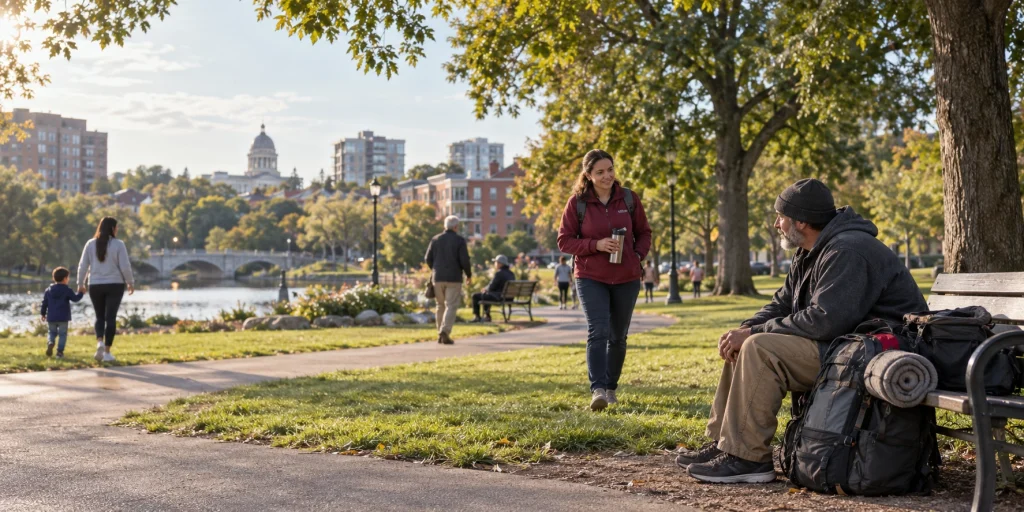
Over the past two months, I have walked through the Traditional Gardens multiple times a week at various hours of the day. At no point have I seen visitors admiring the flowers (there are no gardens), families picnicking, or people lying on blankets reading books. Instead, a loud group of men often gathers at the sunken garden. Smaller groups of men and women sit beneath the trees, often surrounded by bicycles. Individuals gather along the trail on the western edge with tarps, tents, and shopping carts. It is a scene that easily, and often, draws the sentiment that “the homeless have taken over the park.”
Homelessness results from a variety of complex circumstances, personal histories, and events. Yet as varied as individual stories are, the resulting condition is rooted in land and property ownership. By definition, an individual or family experiencing homelessness neither owns land nor can afford to rent land owned by someone else. Public parks represent some of the last truly common spaces in our communities. So, it is not surprising that those without access to private property would gather there.
The problem is that the people who live across the street from the Traditional Gardens do not feel free to use that public space. This refrain resonates throughout the community. In recent surveys by the City Parks Department, Colorado Springs residents say they do not feel safe in their parks. Those feelings are understandable and cannot be dismissed. When public spaces like parks become unusable to anyone, something genuinely important is lost; however, the assertion that homeless individuals are the source of danger is an inaccurate generalization.
Being unhoused is a status, not a character type. As those who work or volunteer with people experiencing homelessness know, there are all kinds of character types within that status — the same as in any cross-section of society, whether defined by occupation, education, disability, or gender. In my experience, and in my observations walking through the Traditional Gardens this summer, unhoused people are more often the targets than the perpetrators of “dangerous” activity. There exists a criminal element that preys on our unhoused neighbors, whether through the sale of drugs, trafficking, assault, or robbery, because they have identified the unhoused as soft targets. Their status makes them less likely to call the police, to be believed, or to be missed.
This distinction matters in how we respond. If the problem were simply that homeless individuals make parks unsafe, the answer would be to remove them. But if the real threat is a criminal element exploiting an unprotected population in an under-monitored space, the answer looks different: law enforcement focused on the predators, outreach that gets vulnerable people into housing and treatment before they can be exploited. Most importantly, if we want to address concerns about the safety of public property, we must address the accessibility and affordability of private property.
This is where ownership and what that ownership requires of us becomes more than a legal question. In 1891, Pope Leo XIII wrote in his encyclical Rerum Novarum (On the Condition of Labor) that private property is not a legal convenience invented by governments, but a natural right “derived from nature, not from man,” and that confiscating what belongs to a person “would rob the lawful possessor, distort the functions of the State, and create utter confusion in the community.” Pope Leo XIII was clear that state ownership of property (as is being suggested today in the United States by members of the Democratic Socialists of America) is not the answer. A century later, St. John Paul II added a crucial qualification in his 1987 encyclical Sollicitudo Rei Socialis (On Social Concern): “Private property, in fact, is under a ‘social mortgage,’ which means that it has an intrinsically social function, based upon and justified precisely by the principle of the universal destination of goods.”
Markets built on ownership have lifted more people out of poverty than any other economic arrangement in history. But when land and housing are treated purely as commodities, with no regard for those who get priced out, the market stops being a stabilizing force and becomes a barrier. It leaves those who are unhoused without a stake in the system. For an individual without ownership or access to private property, public property remains the only space available. When the market provides no answer to this reality, the social mortgage on private property comes due. We pay in part with our parks.
General Palmer gave his wildflower garden to the City of Colorado Springs as a gift for all residents and visitors to enjoy. Like all public parks, it cannot be “claimed” by any group or individual for any reason. It belongs to the neighbors who want to enjoy the paths and the kids who wish to play in the fields, and it also belongs to the man who has nowhere else to go and who never asked to be preyed upon. It does not belong to those who would keep others out through intimidation, criminal activity, littering, or forced removal. If we want to keep parks and public spaces safe and usable for the people they were meant for, we must preserve both the legitimacy of ownership and its social mortgage.
Andy Barton is the President & CEO of Catholic Charities of Central Colorado. This article first appeared in the October 2026 issue of the Catholic Herald.

Leave a Reply