
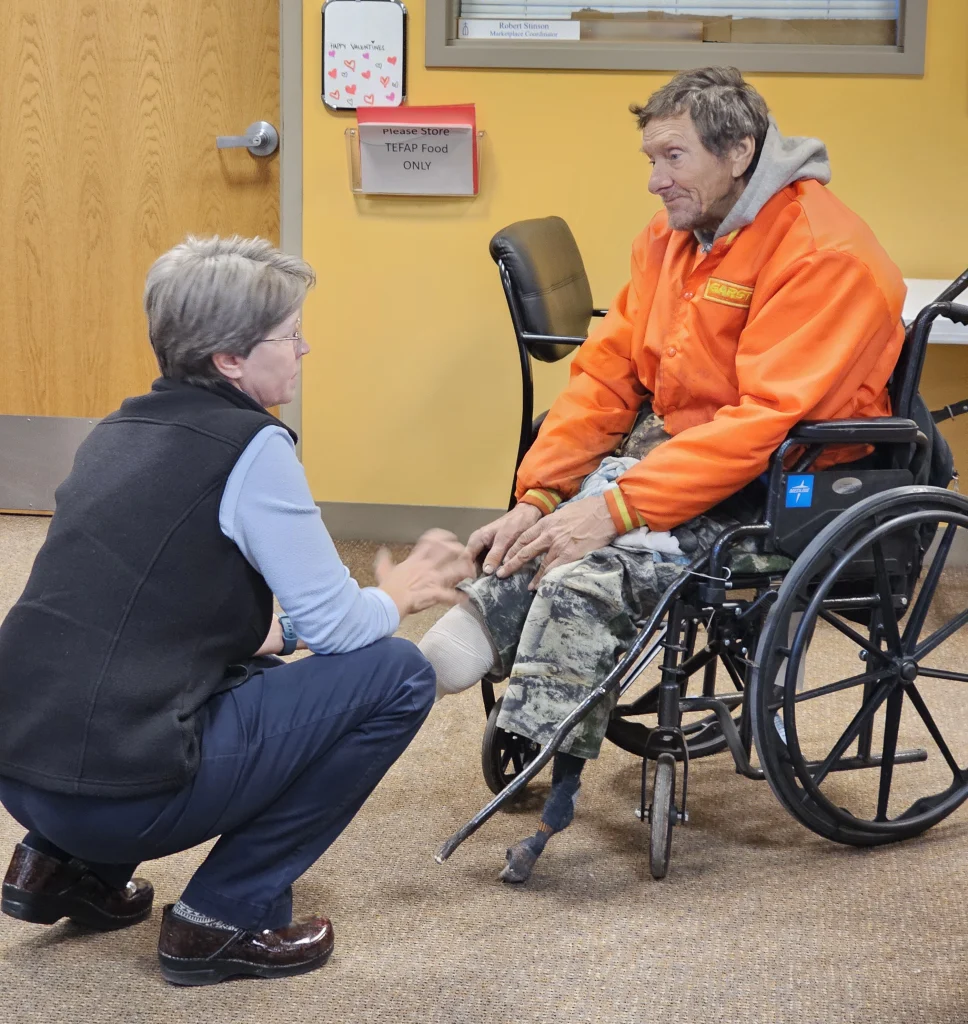
“You should go talk to Velda,” everyone told me when I started working at Catholic Charities. “You really should.” Velda is a Faith Community Nurse who works three days a week at the Marian House. Many of our clients see her for medical care, and she is well known in the community. Velda reminds me so much of an aunt who always knew the answer. You feel safe around her, but you also feel like she is going to take action.
Velda treats people who live on the streets for things like frostbite (when it gets too cold) or exposure (when it gets too hot). She finds people replacement crutches when their crutches are stolen, and replacement glasses when their glasses break. She finds deals for them on dental work so they can get their teeth pulled. She’s everyone’s aunt, really.
I believe in this kind of engagement. Let’s not start with the hardest part. Let’s not start by asking someone why they are homeless and judging them for choices they made. Instead, let’s offer them what they say they need, right at that moment. Help me with this tooth that keeps hurting; help me replace my glasses. Let’s make their lives easier and build relationships. Only then can the much more difficult work begin.
And yet there’s another piece to the story of chronic homelessness.
Back to Velda. I walk across the waiting room inside the Marian House and sit in her small office. We talk about many of the people she treats. “It’s not love,” she says. “It’s not love to let someone walk around outside, yelling at the walls. How is that love?”
There are many people we see who are homeless and who do not have mental illness. They need engagement, like a pair of new glasses. Like people knowing their name.
And then there are people with untreated, severe mental illness. Since being here, I’ve been privileged to talk more with advocates about this issue. And the people closest to the issue are asking for things that surprised me: the ability to keep people in the hospital longer, to treat them so that they can come out of psychosis, to support them through long-acting drugs that need less maintenance. They are asking for a stronger system, not necessarily a more compassionate one. Because in the name of compassion, we let people stay out on the streets, people who are out of their minds. Like Velda said, “that’s not love.”
To learn more about this work, visit https://www.comadmoms.org/.

Leave a Reply